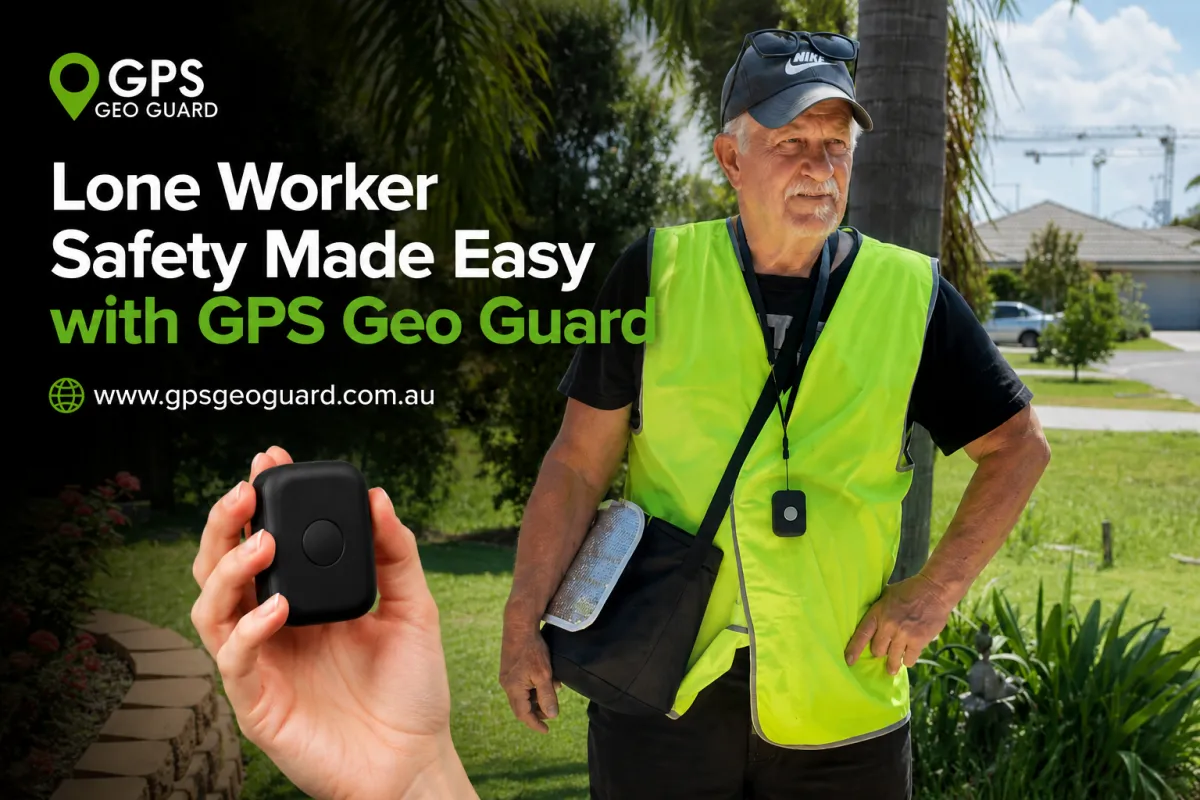
How GPS Geo Guard Can Help Your Business Comply with Lone Worker Safety Regulations
A lone worker is anyone who carries out their duties without a colleague nearby or in sight. Not just the utility or mine worker in a remote field, or the security guard on a night shift. It could be the nurse doing community rounds. Most people still believe “lone or isolated workers” are miners or people working out in the bush.
This couldn’t be further from the truth, and this one misunderstanding is putting thousands of workers at risk every day.
Here’s the truth:
Lone, isolated, and high-risk workers are everywhere:
Retail staff opening or closing
NDIS workers & allied health clinicians doing home visits
Real estate agents & property managers
Tradespeople in private homes
Teachers, childcare & education staff
Aged care & home care teams
Rangers, inspectors & council officers
Delivery drivers, cleaners, security, and hospitality staff
Anyone walking to their car alone
Anyone behind a closed door without immediate support
And the biggest myth of all?
“It won’t happen to us.”
In reality:
OVA (Occupational Violence & Aggression) is rising across ALL industries
Psychosocial WHS obligations are now enforceable
Slips, trips, falls & sudden medical events are increasing with an ageing workforce
Staff are becoming isolated far more often than organisations realise
A policy cannot save someone during an emergency. But Geo Guard can.
If something goes wrong and no one is around to notice, they’re a lone worker.
Under Australia's Work Health and Safety legislation, employers carry a legal duty to protect anyone working alone. The risks are specific and serious — occupational violence, a slip and fall in an isolated location, a medical emergency where the signal is poor, and the next check-in is hours away. What connects all of them is the same thing: no one nearby to help, and no system in place to know something is wrong until it's too late.
That gap between having a policy and having a PERS Personal Emergency Response System for Time Critical Emergencies is where most businesses are more exposed than they realise. GPS Geo Guard exists to fix that gap. This blog reveals exactly how GPS Geo Guard helps businesses with lone worker safety regulations.
What the Law Actually Requires
Australian workplace safety legislation is not ambiguous about what businesses owe their lone workers. The obligations exist whether the employer is aware of them or not. Here’s what the law actually requires.
Duty of Care
Every employer carries a legal duty to protect workers, including those operating alone. Distance does not reduce that responsibility, nor does industry, business size, or the fact that the worker volunteered for the role. PCBUs are also responsible for subcontractors, and here is the big one that many organisations are unaware of: working at Home, you have the responsibility for your staff even when they are working from home. If they are performing work duties and no colleague is nearby, the duty of care is fully in effect.
Hazard Identification and Risk Control
Knowing risks exist is not enough. The law requires businesses and organisations to assess that risk and put something real in place to manage it. A note in a policy document acknowledging that lone work carries risks is not a control measure. It’s a liability.
Information, Training & Supervision
Workers need to understand the conditions and risks they will encounter: the specific hazards of their role, how to use the lone worker alarm safety tools they have been given, and what the actual plan is if something goes wrong. A general induction from three years ago does not meet this standard.
Communication Systems
Australian WHS laws require employers to implement reasonably practicable measures to maintain communication with isolated workers. A personal mobile phone with patchy coverage in half the locations a worker visits may not meet the standard, depending on the work environment and applicable regulatory guidance. What if a worker is knocked unconscious and unable to use the phone?
Emergency Plans
Generic workplace safety policies do not satisfy this requirement. The plan needs to reflect the actual risks of isolated work: who gets notified, how quickly, and what happens next.
Each state and territory enforces these obligations through its own regulator. The standard applied is whether a business has done everything reasonably practicable to protect its people. Most businesses that face scrutiny after an incident discover that the bar was higher than they assumed.
Where Most Businesses Fall Short
Knowing the law exists and actually meeting it are two very different things. Most businesses are not wilfully negligent; they are simply running systems that were never built to handle the real demands of lone worker safety in Australia. These are the gaps that appear most often.
They have a policy document but no functioning safety system behind it.
They write risk assessments from a desk, not from the environments their workers actually face.
They hand workers a personal mobile phone and consider the safety obligation met.
They have no defined escalation process for when a worker goes silent.
They conduct induction training once and never revisit it.
They only review their safety systems after something has already gone wrong.
The Laws are in place, and we all have an obligation.
Here is the kicker - business insurance will not cover WHS Infringements, and everyone who could have played a role in preventing the incident is responsible and liable now.
None of these is uncommon. That is precisely what makes them dangerous. Under Australian WHS legislation, the standard is whether a business has done everything reasonably practicable to protect its workers, and that bar is applied to systems, not intentions. When incidents are investigated, the findings frequently point not to a single catastrophic failure, but to a pattern of small gaps that were never identified or addressed.
The Real Risks Lone Workers Face
The gap that we just highlighted doesn’t exist in isolation. They have consequences. The risks they face are varied, but the consequences of getting it wrong are the same across all of them.
That changes everything about how risk plays out.
A medical episode with no one nearby to help or call for assistance
An aggressive or threatening encounter with no backup and no witness
An accident in a remote location where emergency services are a long way away
A fall or injury that becomes critical simply because the worker cannot reach their phone
Prolonged isolation quietly wears down mental health over time
Exposure to heat, hazardous substances, or confined spaces, with no one aware that anything has changed
In a normal workplace, colleagues catch things. A person looks unwell, someone notices. A situation turns dangerous, and someone steps in. Lone workers do not have that. When something goes wrong, everything depends on how fast help can be reached, and whether the right systems are there to make that happen.
What Non-Compliance Actually Costs
Non-compliance with lone worker safety obligations does not just create risk for workers. It creates serious financial, legal, and reputational risk for the business itself. Under Australian WHS legislation, penalties for safety breaches can be significant, and they have increased considerably in recent years.
The cost of getting it wrong extends well beyond any fine.
Legal costs from investigations, hearings, and prolonged regulatory scrutiny.
Civil liability claims from injured workers or their families.
Workers' compensation costs rise sharply after a serious incident.
Reputational damage that affects recruitment, client relationships, and public perception.
Operational disruption while investigations are conducted and systems are overhauled under regulatory pressure.
Beyond the numbers, there is something harder to quantify. A serious incident involving a lone worker, one that could have been prevented with the right system in place, does lasting damage to a business in ways that no fine captures. Staff loses confidence. Trust erodes. And the knowledge that something was preventable is not something a business moves on from quickly.
How GPS Geo Guard Closes the Compliance Gap
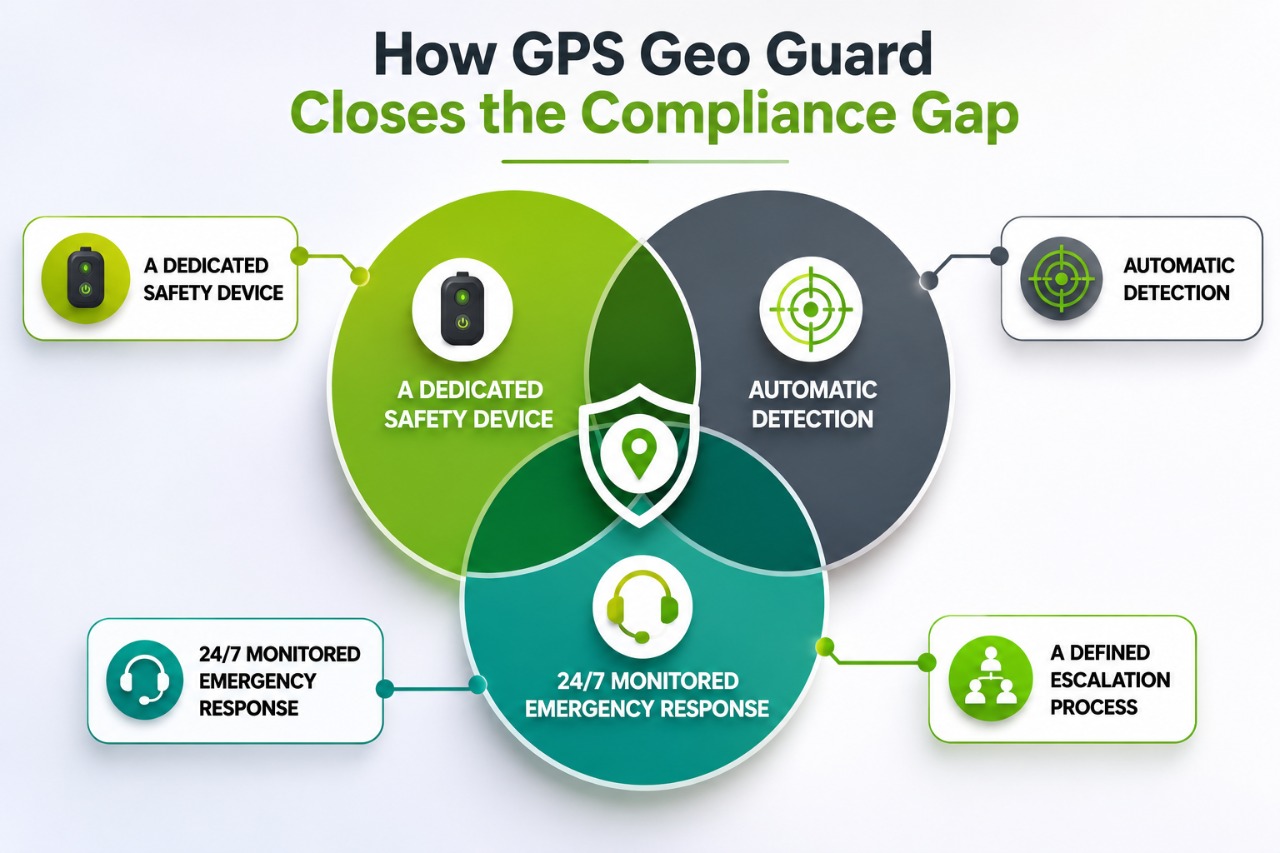
Every gap identified earlier in this blog has a practical answer. GPS Geo Guard is built to address them directly, not in a general sense, but in the specific ways that Australian WHS legislation demands. Here is how we help businesses close the gap between having a policy and having a system that works.
A dedicated safety device
GPS Geo Guard is not a mobile phone app or a casual check-in system. We have a dedicated personal emergency safety device offering fall detection, SOS alarm with live and recorded audio, and real-time GPS location tracking, purpose-built for workers operating alone or in high-risk environments.
Automatic detection
One of the most serious lone worker scenarios is incapacitation, where the worker cannot press a button or make a call. GPS Geo Guard's man-down alarm system features automated alerts that activate when a worker is incapacitated or cannot request help, ensuring their location and situation are immediately known, even if they cannot manually trigger an alarm.
24/7 monitored emergency response
A lone worker safety device or PERS that sends an alert to an unmonitored inbox is not a safety system. GPS Geo Guard connects instantly to our Government certified A1 R1-A 24/7 emergency monitoring ARC (Alarm Receiving Control room) and professional incident monitoring team, providing live GPS location and breadcrumb tracking and live and recorded audio to triage the incident, talk back and comfort the worker, connected to a live operator in 5-7 seconds, with priority first responder emergency services despatch for the fastest possible response along with total event and incident management advising business unit managers or family members for a personal use device until everyone is safe.
We all deserve the right to go to work and come home the way we left!
A defined escalation process
The absence of a clear escalation process is one of the most common compliance failures businesses face. GPS Geo Guard removes that gap entirely. When an alert is triggered, there is a trained employee safety monitoring team, a defined response protocol, and direct links to first responders, not a policy document that assumes someone will notice.
GPS Geo Guard PERS Personal Emergency Response System helps over 7000 organisations comply, safeguard their organisations from WHS litigation, and protect WHS HSEQ safety managers from personal litigation at the same time as offering the Gold Standard safety, protection, and wellbeing for the most valuable asset in any business - Our People!
GPS Geo Guard PERS have 100% user uptake and a 5-star rating with all of our clients across Australia. People want something simple, fast, cost-effective, and reliable.
We’re also proud of our social impact commitment and have saved many lives over the years. We are personally touched about: each Geo Guard sold goes towards funding another life-saving device for a Domestic Violence survivor — “One device. Two lives saved.”
The industry changes. The environment changes. The risks change. But the obligation to keep lone workers safe does not. GPS Geo Guard works across healthcare, retail, government, logistics, disability services, and aged care for exactly that reason.
Conclusion
The reality is that most businesses do not discover the gaps in their lone worker safety until something goes wrong. By that point, the regulatory, financial, and human costs are already in motion. The time to build a system that works is before it is needed, not in response to an incident that could have been prevented.
GPS Geo Guard has spent decades working with businesses across Australia to do exactly that. Not by adding complexity, but by putting the right technology, monitoring, and response capability in place so that when a worker needs help, it is already there.
If your current system would not hold up under scrutiny, it is not a system. It is a risk.
Talk to the GPS Geo Guard team today and find out how we can help your business meet its obligations and protect the people who keep it running.
Lone Worker Safety
Frequently Asked Questions (FAQs)
1. Is GPS Geo Guard just a panic button?
No. It includes automatic man-down detection with zero false alarms, GPS location and breadcrumb tracking only on alarm activation, to create better user acceptance, live audio, and a Government Certified A1 R1-A 24/7 Emergency monitoring, incident management, professional control room operator team that despatches first responders through our exclusive priority despatch system, total event and incident management advising all business managers until the event is closed and everyone is safe. A panic button does nothing if the worker cannot press it.
2. What happens after an alert is triggered?
The monitoring team connects instantly, communicates with the worker, confirms their location, and coordinates first responders in real time.
3. What types of incidents can GPS Geo Guard handle?
The monitoring team is trained to respond to workplace violence, falls, health emergencies, environmental risks, and domestic violence situations.
4. Is GPS Geo Guard suitable for high-risk and remote work environments?
Yes. It is used across construction, utilities, government, healthcare, and other industries where workers regularly face isolated or unpredictable conditions.
5. We already have a safety policy. Do we still need this?
A policy documents intentions. GPS Geo Guard protects workers when those intentions are tested. Under Australian WHS law, a written policy alone does not satisfy the duty of care.


