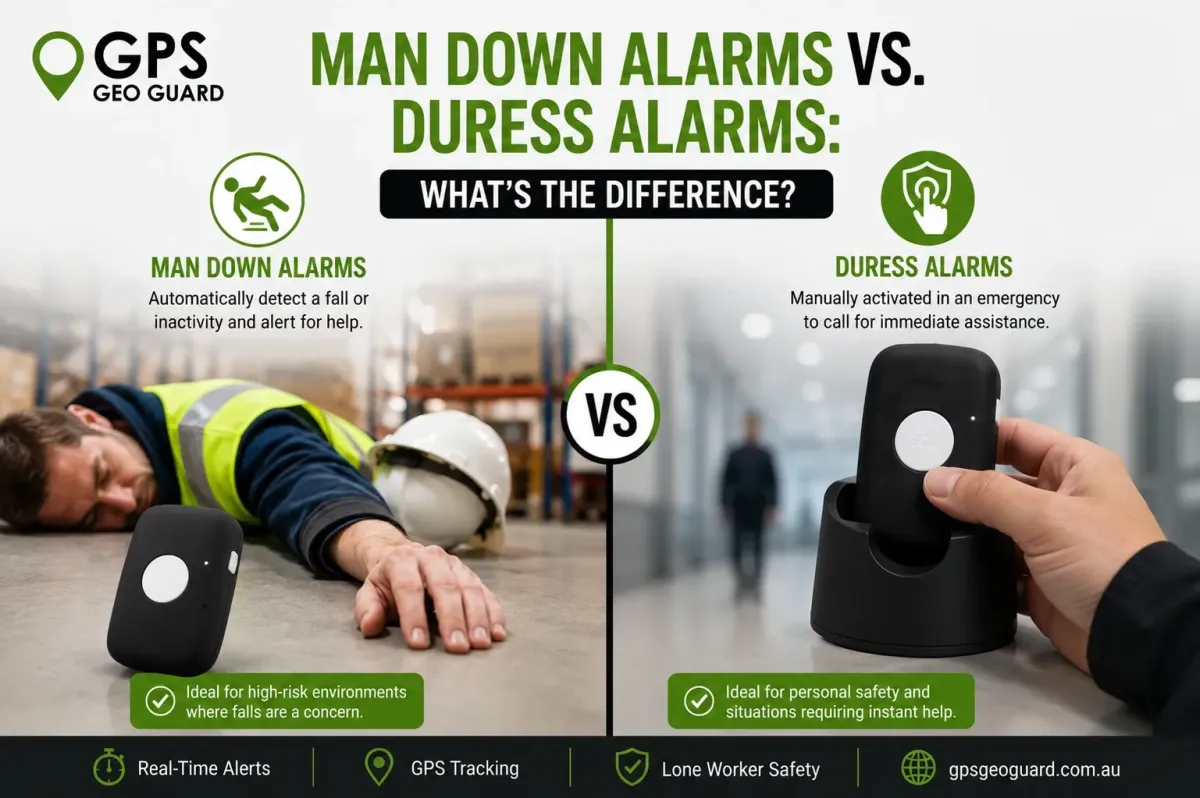
Man Down Alarms vs Duress Alarms: What's the Difference?
Lone worker safety technology has come a long way. But the confusion between man down alarms and duress alarms is still one of the most common gaps businesses overlook. Both devices exist to protect workers. But choosing the wrong one, or assuming one covers what the other does not, can leave workers exposed in exactly the situations these devices are meant to handle.
Each alarm is designed for a different scenario, responds to a different type of risk, and activates in a fundamentally different way. Understanding the distinction isn’t just useful knowledge for a safety manager. It’s the difference between having the right system in place and having one that fails at the exact moment it is needed the most.
This blog breaks down how each alarm works and what the difference between the two actually is, so that you can make an informed decision about what your workers genuinely need.
What is Man Down Alarms
A man down alarm system is a personal safety solution designed to detect when a worker falls, becomes incapacitated, or remains motionless for an extended period. These man down alarm devices use built-in sensors to identify potential emergencies and automatically send an alert to a monitoring centre when a worker may be unable to request assistance.
In Australia, man down safety devices can help protect lone workers in industries such as construction, healthcare, utilities, aged care, and disability support. Depending on the device, features may include fall detection, GPS location tracking, two-way audio, and 24/7 emergency monitoring.
How Does it Work?
Man down alarms use built-in sensors, including accelerometers and motion detectors, to monitor the worker's movement in real time. When the device detects a fall, a sudden impact, unusual movement, or prolonged inactivity, it triggers an alert automatically.
That alert is immediately transmitted to the 24/7 emergency monitoring centre. The team receives the alarm along with the worker's live GPS location, opens an audio channel to assess the situation, and despatches first responders if required. The event stays open until the worker is confirmed safe.
Use Cases
Man down alarms are most critical in situations where a worker is unable to manually trigger an alert:
A construction worker who loses consciousness after a fall on an isolated site
A healthcare professional who collapses during a home visit with no one nearby
A warehouse technician who suffers a medical episode working alone after hours
A utility worker in a remote location incapacitated by an environmental hazard
A disability support worker who is overpowered and cannot reach their device
What is Duress Alarms
A duress alarm is a personal safety device that allows a worker to request emergency assistance when they feel threatened, unsafe, or at risk. Commonly used as a workplace duress alarm, it typically activates when the worker presses an SOS button, sending an alert to a monitoring centre along with their location when supported by the device.
A GPS duress alarm can help monitoring operators identify a worker's location and coordinate an appropriate response. These devices are useful for lone workers, healthcare professionals, retail staff, government field officers, and disability support workers who may need assistance while working alone.
How Does it Work?
Pressing the SOS duress alarm button sends an instant alert to the 24/7 emergency monitoring centre, along with the worker’s real-time GPS location. A professional operator connects instantly through live audio, listens in, assesses the situation, and provides comfort to the worker while coordinating the response. First responders are dispatched if required. All audio is live and recorded, creating an accurate and admissible record of the incident that can be used as evidence if the situation escalates to a legal matter.
The entire process from button press to operator connection takes seconds, not minutes. For a worker in a threatening situation, that speed is everything.
Use Cases
Duress alarms are built for situations where a worker can recognise a threat and act on it:
A retail worker confronted by an aggressive or threatening customer
A community health nurse who feels unsafe during a home visit
A government field officer facing a volatile situation on site
A disability support worker who needs immediate backup from a difficult client encounter
An NDIS worker or aged care professional dealing with an unpredictable situation alone
Difference Between Man Down and Duress Alarms
The core difference comes down to one thing: whether the worker can ask for help themselves.
A personal duress alarm requires the worker to be conscious, aware of the danger, and physically able to press the SOS button. A man down alarm removes that requirement entirely. It acts on the worker's behalf when they cannot act for themselves.
Both alarms serve the same ultimate purpose. But they are built for fundamentally different situations, and understanding that difference is what determines whether a business has the right system in place or just part of one.
Many lone workers face both types of risk depending on their role and environment. That is why the most effective safety systems cover both, not one or the other. Because a worker in the field could encounter an aggressive or threatening situation and need to manually call for help. That same worker could also suffer a fall or medical episode minutes later and be completely unable to press anything. Both scenarios are real. Both require a different type of protection.
Choosing one alarm and assuming it covers everything is one of the most common gaps in lone worker safety. A duress alarm for lone workers will not help a worker who is unconscious. A man down alarm will not respond to a threat the sensors cannot detect. The question is not which alarm a business needs. For most lone worker roles, the answer is both.
How GPS Geo Guard Protects Against Both Risks
The Geo Guard Duress is a PERS (Personal Emergency Response System) built to cover both risks in a single device. It combines manual SOS duress activation and automatic man down detection, so a worker is protected whether they can call for help or not.
One press for immediate help
Pressing the single large SOS button sends an instant alert to the Government Certified A1 R1-A 24/7 emergency monitoring centre. A friendly, professional control room operator connects within seconds, opens live audio, assesses the situation, and despatches first responders through a priority despatch system. Total event management continues until everyone is confirmed safe.
Automatic detection when a worker cannot act
If a worker falls or becomes incapacitated, the Geo Guard Duress detects it automatically using proprietary sensor technology and triggers an alert without the worker needing to do anything. Zero false alarms means every alert that reaches the monitoring centre is a real one.
Precise location indoors and outdoors
Accurate GPS and breadcrumb tracking outdoors and BLE indoor positioning give the monitoring team and first responders an exact location in real time, not an approximate area.
Live and recorded audio on every incident
Every alert captures live and recorded audio, giving the monitoring team real-time awareness and an accurate record of the event that can be used as evidence if required.
Trusted by over 7,000 organisations across Australia with a 100% user uptake and 5-star rating, the Geo Guard Duress removes the need to choose between two types of protection. It delivers both in one device, backed by the fastest monitored emergency response in Australia.
Conclusion
Lone worker safety is not a single problem with a single solution. A worker can face a threatening situation in the morning and suffer a fall in the afternoon. The risks do not stay in one category, and a safety system that only covers one of them is not enough.
That is the reality most businesses are not accounting for. They invest in a device, tick the box, and assume the problem is solved. But a duress alarm system that sits useless next to an unconscious worker is not protection. And a man down device that cannot respond to an aggressive encounter leaves an equally dangerous gap.
GPS Geo Guard solves that issue. Find out how the Geo Guard Duress protects your workforce across every situation. Book a demo or get a quote today.
Frequently Asked Questions (FAQs)
1. Can one device replace both a man down and duress alarm?
Yes. The Geo Guard Duress combines both functions in a single device, removing the need for two separate solutions.
2. What industries need both man down and duress protection?
Any industry where workers face both physical hazards and personal safety risks, including construction, aged care, disability services, retail, and government field work.
3. Will a smartphone app provide the same protection as the Geo Guard Duress?
No. Apps depend on the worker having their phone, adequate battery, mobile coverage, and the ability to open the right screen under stress. The Geo Guard Duress is a dedicated device that works independently of a smartphone.
4. Can the Geo Guard Duress be used indoors?
Yes. It uses BLE indoor positioning to provide accurate location tracking inside buildings, not just outdoors.
5. Is the Geo Guard Duress suitable for small businesses?
Yes. GPS Geo Guard is scalable and works for businesses of any size, from a single lone worker to large organisations across multiple locations.
6. What is the difference between a medical duress button and a general panic alarm?
A medical duress button is generally used to request assistance during a medical emergency or when someone needs urgent support. A general panic alarm is typically used to alert others when a person feels threatened or requires immediate help. The exact functions depend on the device and monitoring service.
7. What is the difference between a panic button and a duress alarm?
A panic button is the button used to activate an emergency alert, while a duress alarm refers to the wider safety device or system that sends the alert and connects the user to assistance. The terms are sometimes used interchangeably, depending on the product and industry.
8. Can a man down alarm system work without the worker pressing a button?
Yes. A man down alarm can automatically detect certain falls, impacts, or periods of inactivity, depending on its sensor technology and settings. This allows the device to send an alert when a worker may be unable to request assistance manually.


