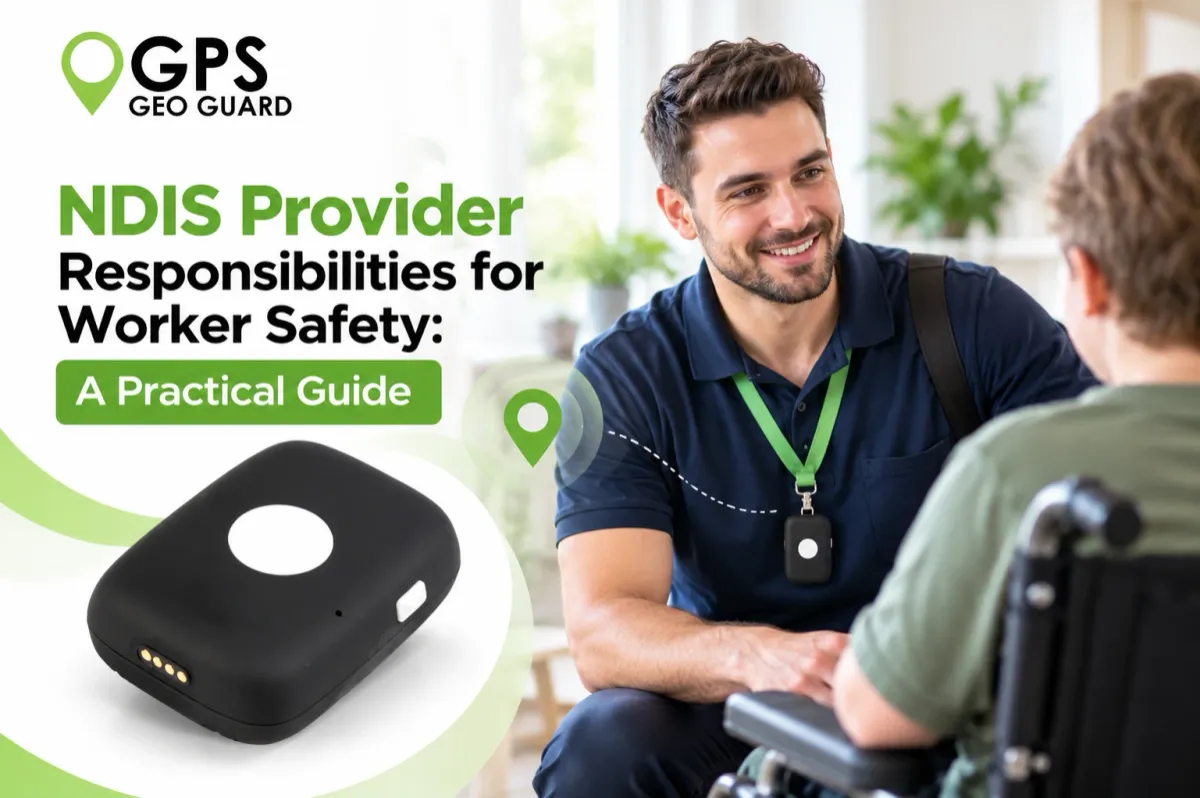
NDIS Provider Responsibilities for Worker Safety: A Practical Guide
Disability support work is often done alone, inside a participant’s home, with little control over what happens next. When a worker has no way to call for help, even a simple situation can turn serious fast.
That’s where NDIS provider responsibilities come in. They are the duties a provider holds to keep workers safe: protecting them from violence and aggression, assessing risks before they cause harm, and giving them the training, procedures, and tools to get help when they need it. In this blog, we’ll look at what those responsibilities involve, how to run a worker safety risk assessment, and how duress alarms protect lone workers.
Understanding NDIS Provider Responsibilities for Worker Safety
If you run an NDIS (National Disability Insurance Scheme) support business, your workers’ safety is your responsibility, just as it is for any employer. WHS law expects you to find the risks in their work, control them, and keep your team trained and involved along the way.
If you’re a registered provider, the NDIS Practice Standards add to that, because they require you to manage risks and incidents for workers as well as participants. In plain terms, NDIS provider responsibilities for worker safety mean knowing what could go wrong, having a plan for it, and giving your workers a way to get help.
Common Safety Risks Faced by NDIS Support Workers
NDIS support providers can’t control a worker’s safety until they know what that worker is exposed to. A worker safety risk assessment should start with these risks:
Violence and aggression: from participants or, at times, their families
Manual handling injuries: from transfers, lifting, and personal care
Slips, trips, and falls: in wet bathrooms, cluttered rooms, and unfamiliar layouts
Psychosocial hazards: burnout, emotional strain, and exposure to distressing situations
Lone worker risk: an incident that no one else sees
These risks change from one participant and one home to the next, so each worker’s assessment needs to reflect the specific situation they’re walking into.
How to Conduct a Worker Safety Risk Assessment
A worker safety risk assessment comes down to four steps. Do them for each participant, since every home and every person’s needs are different.
Spot the hazards: check the participant’s history, the home, and the tasks the worker will do
Evaluate each one: ask how likely it is to cause harm and how bad that harm could be, and for lone workers, add how far they’ll be from help
Decide what to do about it: remove the hazard if you can, and if you can’t, reduce it with training, a clear procedure, or a device that calls for help
Write it down and revisit it: keep a record, and look again when something changes
These steps tell you where your workers are most at risk before a shift even starts. They also leave you with a written record showing you’ve met your WHS duties.
How to Manage Lone Workers Safely
Five things do most of the work in managing lone workers. Each one covers a different way a response can go wrong.
A Lone Worker Procedure
Plenty of providers have an emergency number written down somewhere. A procedure goes further, because it settles the questions people end up arguing about at the worst moment:
What counts as a trigger, such as a missed check-in or a duress alert
Who responds first, and who steps in if they can’t be reached
How long each stage runs before the next one begins
Once those are agreed, nobody has to work out who acts. WHS law has its own expectations here, and the employer responsibilities for lone worker safety guides cover them.
Check-Ins
A check-in sets a time when you expect to hear from the worker. When that time passes quietly, somebody notices. It only helps if a missed one sets something off, because the worker who stops checking in is often the one who needs help.
An Escalation Path
Without one, an emergency lands on whoever happens to spot it, and that can take hours. A set order of contacts, with a point where emergency services come in, takes the luck out of it. A monitored alarm escalation process runs the same way: alert, trained operator, dispatch, then confirmation that the worker is safe.
Training
A worker usually handles the first few minutes of any incident alone, so what they know counts. Good training covers:
Calming an aggressive or distressed situation
What to do after a fall or a medical emergency
How the safety equipment works
Roles and participants change over time, which is why training gets revisited rather than done once.
A Way to Call for Help
A phone call needs a conscious worker who can explain where they are. Workforce duress alarms ask for one button press, and the alert carries the worker’s GPS location. Fall detection sends it when the worker can’t press anything. A 24/7 monitoring team picks up each alert, assesses it, and sends help.
How Duress Alarms Help Protect Disability Support Workers
NDIS providers have to protect workers from violence and aggression, manage the risks in their work, and handle incidents properly. A duress alarm gives them a practical way to act on each of those duties, because it puts a response in the worker’s hand.
Workforce Duress Alarms and Personal Duress Alarm
Workforce duress alarms cover a whole team under one monitoring and escalation system. A personal duress alarm in Australia, such as , supports workers and providers in these ways:
Aggression: one press of the SOS button opens live audio, so a trained operator hears what’s happening and sends help. This is a direct control for the violence and aggression risk providers are expected to manage.
Falls and medical events: man down detection sends an alert when a worker can’t press anything, which covers the manual handling and fall risks found in the risk assessment.
Location: GPS outdoors and BLE indoors tell the monitoring team where the worker is, including at a new participant’s address.
Incident handling: each alert follows a defined escalation process through to event closure, which gives the provider a clear account of how an incident was managed.
Disability Panic Alarm Devices
Provider responsibility covers participants as well as workers. GPS Geo Guard’s Disability Panic Alarm is built for NDIS participants and SIL residents, with one-touch SOS, vibration activation, and safe word recognition. It gives providers a way to look after both people in the same visit.
Conclusion
NDIS provider responsibilities for worker safety get tested at one moment: when a worker needs help and the provider’s plan has to deliver it. Risk assessments, procedures, and training prepare for that moment, and a duress alarm with 24/7 monitoring is what responds when it arrives. GPS Geo Guard has spent 38 years building that response for Australian workers, from the first alert to the final all-clear.
To see how workforce duress alarms and the Disability Panic Alarm would work for your workers and participants, book a demo or request a quote from GPS Geo Guard.
Frequently Asked Questions (FAQs)
Does the NDIS require providers to give support workers duress alarms?
The NDIS Commission’s worker safety guidance doesn’t specifically require them. Providers still have to manage lone work risk under WHS law, and an alarm is one way to do it.
Do unregistered NDIS providers have worker safety duties?
Yes. WHS law applies to any provider that engages workers, registered or not. The NDIS Practice Standards apply only to registered providers.
Are NDIS providers responsible for contractors as well as employees?
Yes. WHS law covers workers a provider engages directly with or through subcontracting, so contractors count as workers.
Can an NDIS participant be responsible for a support worker’s safety?
Yes, when the participant directly engages their own workers, they make them a person conducting a business or undertaking (PCBU) under WHS law. Their NDIS provider works with them to manage the risks.
What should a provider do after a violent incident involving a worker?
Record the incident, support the worker, and review the risk assessment. Serious incidents may also need notifying to the WHS regulator, and workers can report violence to the NDIS Commission.


