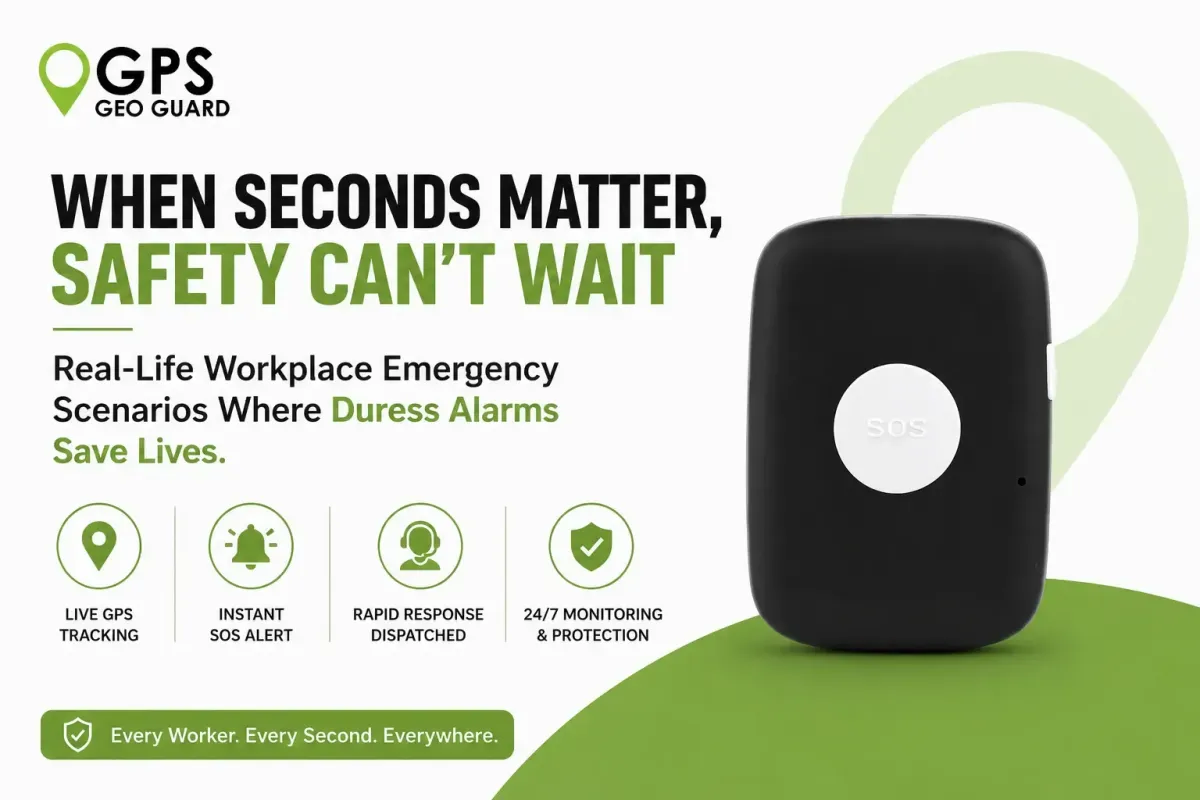
Real-Life Workplace Emergency Scenarios Where Duress Alarms Save Lives
Every workplace with any real risk has a safety policy, training sessions, protocols, and a folder somewhere outlining what to do if something goes wrong. But none of that changes what happens in the moment an emergency actually occurs.
A policy doesn't know where a worker is standing. It can't hear what's happening. It can't call for help on someone's behalf when they're the only one who knows something is wrong. That gap, between having a plan and having help in the exact second it's needed, is where most workplace emergencies actually get decided.
These situations reflect the kinds of risks some industries face every day. Each one shows exactly how a duress alarm system changes what happens next.
Four Real-Life Workplace Emergency Scenarios Where Duress Alarms Save Lives
Scenario 1: A Community Worker Facing Aggression During a Home Visit
Every home visit puts a worker somewhere they don't fully control. Client mood, history, stress on a given day - none of it shows up on a schedule. A welfare check that's routine on paper can turn hostile fast if someone's in crisis, affected by substance use, or going through a mental health episode. There's no reliable way to see that coming.
What makes this hard to manage is the isolation itself. There's no colleague present to help de-escalate, no manager nearby, and often no exit that doesn't risk provoking the situation further. Aggression in a home visit can shift quickly, and because the worker is alone, there's no one else present to recognize early warning signs or step in before things get worse.
An employee safety alarm system built for covert activation addresses this directly. The device allows the worker to signal for help in the moment, without speaking, reaching for a phone, or doing anything visible to the person causing the aggression. Through covert, one-touch activation, that action immediately sends live audio and their exact GPS location to a 24/7 monitoring team, who assess the situation and dispatch help.
Scenario 2: A Lone Technician Injured in a Confined Space
Confined-space work sends a technician somewhere colleagues usually aren't, spaces with limited access, poor visibility, and often unreliable mobile signal. In that kind of environment, even a minor incident becomes serious fast. A fall, an electric shock, exposure to gas - any of these can leave a worker unable to move or call out, and with no one else around, there's nobody to notice that something's gone wrong.
This kind of work usually falls to HVAC and maintenance technicians, servicing a unit in a roof cavity or checking equipment in a plant room, spaces that were never really built for regular access in the first place. That's exactly what makes them dangerous. The same conditions that make the space hard to reach also make it hard to leave if something goes wrong, and a worker who's gone down there can stay unnoticed for hours.
This is exactly the situation a lone worker safety alarm is built for. GPS location means a monitoring team knows precisely where the technician is, whether they've fallen, been shocked, or exposed to gas. For spaces where standard signal doesn't reach at all, a satellite-connected option keeps that same location and alert capability working, so a search across the property isn't what stands between the incident and the response.
Scenario 3: An Aged Care Worker Responding to a Resident's Fall
A facility with multiple residents can't have staff watching every room at once. A fall often happens in the moment no one's present, between scheduled check-ins, while a caregiver's attending to someone else down the hall. The resident may not be able to call out or reach a phone, and if the fall happens somewhere out of sightline, minutes can pass before anyone even realizes something's wrong.
This is exactly where response time changes the outcome. The longer a fall goes unnoticed, the greater the risk of complications from lying there injured and untreated. For the resident and their family, that gap between the fall and the moment help arrives is often what separates a manageable incident from a serious one. And it's a heavy thing for care staff to carry too, knowing that even the most attentive caregiving can't always close that gap on its own.
A resident who's fallen may not be able to press a button or call out at all, which is exactly the dependency automatic fall detection removes. The alert fires the instant the fall happens, with no action required from the resident whatsoever.
Scenario 4: A Warehouse Worker Injured Near Heavy Machinery
A large warehouse floor is loud, busy, and spread across a lot of ground, forklifts moving in every direction, conveyor systems running, workers spread across different aisles and levels doing separate tasks. An injury near machinery, a crush, an impact, a fall from height, can happen in seconds and often without anyone close enough to see it happen or hear it over the noise of the floor.
That combination of scale and noise is exactly what makes this kind of injury so dangerous. A worker who's gone down between aisles or behind stacked inventory isn't necessarily somewhere colleagues would think to check, and the time it takes for someone to notice, come looking, and find them is time an injury involving machinery often can't afford. The more physically demanding and high-risk the environment, the more that gap between injury and discovery actually matters.
A commercial duress alarm system closes that same gap between injury and discovery. The moment the alert triggers, it sends the worker's exact location, so nobody has to notice, search, or guess where to look.
How a Duress Alarm System Changes the Outcome in Every Scenario
In each of these situations, the actual danger isn't the incident itself; it's the time between the incident and the moment someone realizes help is needed. In every scenario above, that gap existed for the same reason: the worker had no way to call for help, no one nearby to notice, or no way to signal without making the situation worse. This kind of alert system exists specifically to close that gap.
The community worker facing aggression avoids escalation because help is already on the way before the situation gets worse. The alarm sends a covert signal to a monitoring team the moment things turn hostile, without the worker needing to speak or draw attention to the call for help.
The technician in the confined space doesn't lie undiscovered for hours. GPS location lets a monitoring team direct help to the exact spot immediately, cutting what could have been a prolonged, worsening injury down to a fast, targeted response.
The aged care resident's fall is caught in the moment it happens rather than at the next scheduled check-in. The alert closes that gap, reducing the time spent injured and untreated and lowering the risk of complications from a delayed response.
The warehouse worker near machinery isn't lost in a search across a noisy, sprawling floor. Location data means the risk of a minor injury turning serious from delay is taken out of the equation.
Every one of these outcomes comes down to the same variable: how quickly the right information reaches the right person. A workplace duress alarm doesn't prevent the incident itself; it changes how fast the response begins, and that timing is often what decides how serious things become.
Conclusion
These scenarios aren't unusual. They're the everyday reality of lone work, public-facing roles, and vulnerable-person care across healthcare, government, retail, aged care, and logistics. What separates a manageable incident from a serious one almost always comes down to the same thing: how quickly help finds out something is wrong.
That's the actual case for a duress alarm system, not as an added safety measure sitting unused in a drawer, but as the one link between a worker in trouble and the response that follows, wherever they are and whatever they're facing.
GPS Geo Guard builds that link through GPS location, live and recorded audio, and a 24/7 monitoring team trained to dispatch first responders the moment it matters. If workplace safety planning still has a gap between policy and the moment something actually goes wrong, that gap is worth closing before it's tested by a real incident.
Book a demo with GPS Geo Guard and see how this fits into your team's safety plan.
Frequently Asked Questions (FAQs)
How does a duress alarm alert for help without drawing attention?
Activation is designed to be covert, a discreet signal rather than an audible alarm, so a worker can call for help without alerting whoever they're with.
Does the monitoring team contact emergency services directly, or does the worker have to?
The monitoring team handles it. Once an alert comes through, they assess the situation using live audio and location, then dispatch first responders directly.
Will a duress alarm still work in areas with no mobile signal?
Standard devices rely on mobile connectivity, but GPS Geo Guard also offers satellite-based solutions for workers in remote or signal-poor locations.
Do staff need training to use one?
Yes, every device comes with personalised training, either one-on-one or in a group setting, along with a user guide for reference afterward.
Can these alarms be tailored to a specific industry's risks?
Yes, solutions are customised by industry, since the risks a retail worker faces differ from those of a lone technician or an aged care staff member.


