Workplace Violence Prevention: How Duress Alarms Protect Staff
Workplace violence does not wait for a policy review or a quiet moment to plan a response. It happens in seconds, and in those seconds, what protects a worker is not the document sitting in a filing cabinet. It is whatever system is actually switched on at that moment.
Occupational violence and aggression are rising across Australian workplaces, and it reaches far more roles than most organisations assume. Retail staff, NDIS workers, home help and care assistants, taxi drivers, and transport workers are all facing it more often than the data behind most safety policies account for.
The question for any business with staff exposed to this risk is not whether a policy exists. It is whether that policy translates into something a worker can actually use when they are being threatened, isolated, or unable to call for help themselves. That is where duress alarms for lone workers enter the conversation: the system meant to close the gap between a threat occurring and help actually arriving.
Who Is Most at Risk of Workplace Violence?
Most people picture workplace violence as a security or emergency response problem. The truth is less dramatic and far more common. It shows up in roles that rarely get discussed in the same conversation as risk.
Workers facing this on a regular basis include:
Shop and service sector workers, managing aggressive customers during opening, closing, or peak hours with no one else on the floor
Nursing staff, exposed to unpredictable aggression from patients or visitors, often while attending to someone alone
Home help, care assistants, and cleaners, walking into private homes with no way to know who or what is on the other side of the door
Social workers, institution staff, and community workers, including those visiting clients in homes for allied health or disability support, are regularly placed in volatile situations that can shift without warning
Electrical and maintenance workers, often working alone inside private homes or unfamiliar properties with no colleague present
Taxi drivers and transport workers, confined in a vehicle with a stranger, with no colleague and no easy way out
Parking attendants, metre readers, and delivery and postal workers, working alone in public, are fully exposed to anyone who approaches
What connects every one of these roles is not the industry. It is the absence of a second person, the direct contact with the support system, and no way to predict the moment things turn dangerous.
What Australian WHS Laws Require for Workplace Violence Prevention
Under Australian WHS law, businesses carry a duty to identify and assess occupational violence and aggression as a hazard in its own right, not simply fold it into general lone worker risk. This means employers are expected to assess where staff face direct, unscreened contact with the public or clients and to put controls in place that are reasonably practicable for that specific risk, rather than relying on generic safety policies.
The obligation extends to having a functioning communication system that allows an at-risk worker to summon help in real time, not just a documented process that exists on paper. It also requires an emergency response plan that activates and resolves an incident as it unfolds, with a clear path from alert to action.
For HSEQ and WHS managers, this is where personal liability sits. If a violent incident occurs and the business cannot demonstrate that hazard identification, risk control, communication, and response planning were all in place and operational for that specific risk, the gap becomes a regulatory and legal exposure, not just a safety failure.
Where Most Businesses Fall Short
The gaps usually start in the same place. A risk gets identified, a policy gets written, and the business considers the obligation met. A policy describes intent. It does not function as a system, and it does nothing the moment a worker is actually in danger.
That gap shows up in a few predictable ways:
A personal mobile phone gets treated as the safety plan. It works until the signal drops, the worker cannot reach it, or there is no one watching for the call that never comes.
Nobody has defined what happens after an alert is raised. A business can have a phone, an app, even a button, and still have no answer for who responds, how fast, or what the next step is.
Training happens once and is expected to last indefinitely. A staff member shown a process during induction is not the same as a staff member who can execute it under real pressure years later, in a moment they did not see coming.
Systems get reviewed only after they have already failed once. The review happens in response to an incident, not in anticipation of one.
From the inside, this rarely looks like negligence. It looks like a business that has already addressed the risk. That false sense of coverage is exactly why these gaps go unnoticed during audits and inductions until an actual incident exposes what was missing.
How a Duress Alarm Can Help Reduce Workplace Dangers
When a situation becomes dangerous, most people do not have the composure to pull out a phone, unlock it, and explain what is happening. A duress alarm for lone workers fixes that gap entirely. One press, one discreet motion, and the alert is already moving, no talking required.
Here is what that one action actually changes:
The worker does not need to say anything. The alert fires the second the trigger is pressed, even if they cannot get a word out.
It moves at the same speed the danger does. A nursing staff member with an agitated patient, a taxi driver alone with a passenger, a home help worker behind someone's front door - none of them have minutes to spare. A duress alarm responds in seconds.
It sends the worker's exact location along with the alert. Nobody has to guess where help needs to go, which matters most for anyone working alone in a home, a car, or somewhere unfamiliar.
It can change behaviour just by being there. Workers often feel safer carrying one, and a visible duress alarm may make an aggressor think twice, even if it cannot guarantee that outcome every time.
What a duress alarm does in that first moment matters enormously. What happens in the moments after it is triggered matters just as much, and that is where the right duress alarm system makes all the difference.
How GPS Geo Guard Can Protect Your Staff
Every gap covered so far comes down to one thing: what happens after the alert is triggered. GPS Geo Guard is built to answer that question with a working response, not an assumption.
Every alert connects to a Government-certified 24/7 Emergency Monitoring Centre, where a live operator responds within seconds, listens through live audio, confirms the worker's exact GPS location, and despatches the right response while the incident is still unfolding, not after it has already happened.
The solution is built around a few core devices, each suited to a different layer of risk:
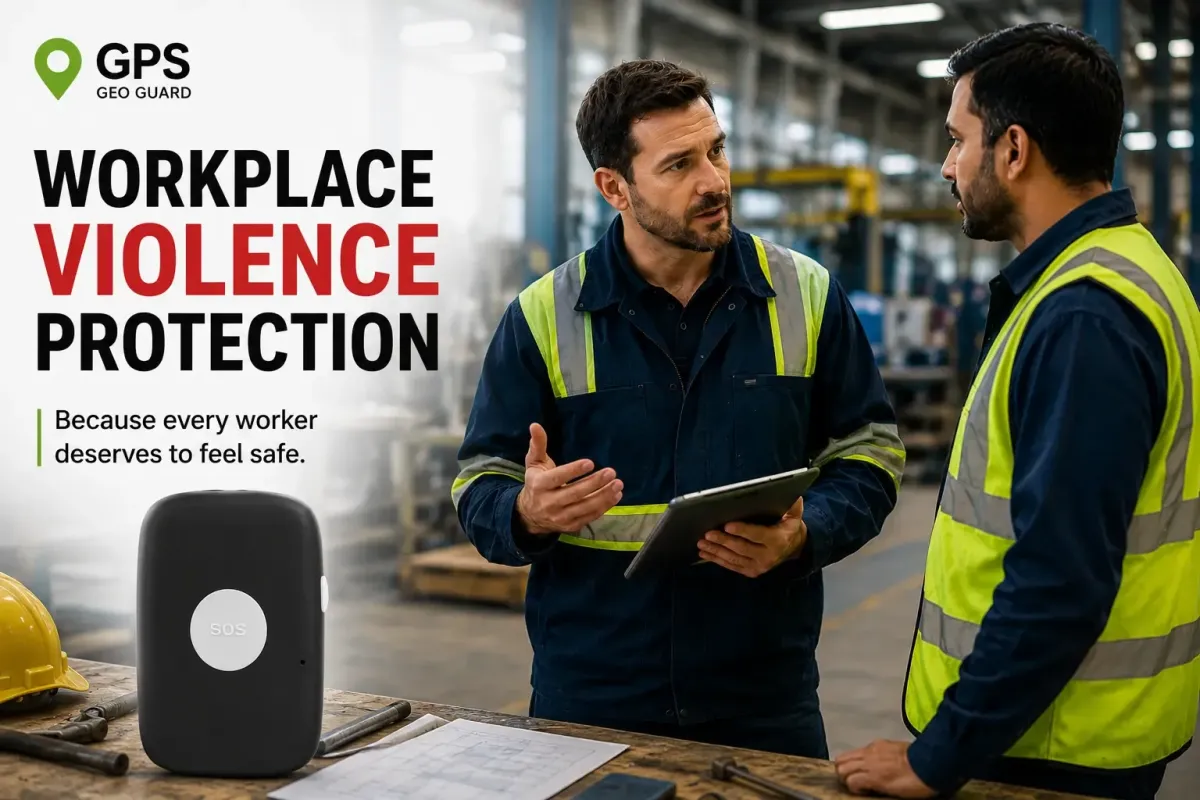
GPS Geo Guard is the core personal duress alarm, a single SOS button paired with automatic fall and incapacitation detection, live audio, and accurate GPS and indoor positioning. It works for shop and service sector workers, taxi drivers, transport workers, and any role facing direct public contact.
Man Down Monitoring Systems are built specifically for incapacitation. If a nursing staff member, a lab worker, or a home help or care assistant is injured or unable to move, the alert still triggers automatically, without requiring them to press anything.
Workforce Duress Alarms extend this protection across an entire team, giving businesses a single, consistent safety system for staff in security, emergency services, electrical and maintenance, and public-facing roles, rather than a patchwork of personal devices and apps.
OmniCare Alert is purpose-built for care-based settings, supporting workers and individuals who need ongoing monitoring alongside emergency response. The OmniCare Alert
Every device feeds into the same response chain. A live person hears what is happening, confirms the location, and moves help immediately, which is the actual difference between an alarm that sounds and a system that protects.
Conclusion
Workplace violence does not wait for a policy to catch up. It happens in seconds, to staff who are often working alone, and a written plan cannot respond in real time. A duress alarm connected to nothing meaningful cannot either. What actually protects shop and service sector workers, nursing staff, taxi drivers, home help and care assistants, and every other role facing this risk is a system built to answer the moment it is needed, not just acknowledge that the risk exists.
That is the gap GPS Geo Guard is built to close.
If your business has not reviewed what would actually happen the moment a staff member needed help, now is the time to look into it.
Explore the duress alarm your business needs, and find out exactly what kind of protection your team is missing.
Learn More:
Future of Workplace Safety: Integrating Technology with Personal Security
How Personal Safety Devices Enhance the Safety of Lone Workers in Australia
How GPS Geo Guard Can Help Your Business Comply with Lone Worker Safety Regulations
Frequently Asked Questions (FAQs)
1. Is a duress alarm the same as a panic button on a phone app?
No, an app-based panic button depends on phone signal, battery, and the worker being able to unlock and operate it. A dedicated duress alarm works independently and connects directly to a monitored response.
2. What happens if a worker is incapacitated and cannot press the alarm?
Man-down detection identifies falls or incapacitation automatically and triggers an alert without requiring the worker to do anything.
3. How fast does a monitored duress alarm actually connect to help?
With GPS Geo Guard, a live operator typically connects within seconds of an alert being triggered, not minutes.
4. Does having a duress alarm satisfy our WHS obligations on its own?
A duress alarm is part of meeting that obligation, but it needs to sit within a defined escalation process and emergency plan to fully satisfy WHS requirements.
5. Can one system protect staff across different roles and risk levels?
Yes, GPS Geo Guard offers different devices, including Geo Guard Pro, Man Down Duress Alarms, and Workforce Duress Alarms, that can be matched to different roles within the same business.


